
Choosing Substrates to Balance Cost and Performance
Smart Substrate Choices for Countertops, Wall Panels and Casework That Optimize Cost, Durability and Sustainability
Selecting the right substrate is a critical step in getting the most value and performance from surfacing materials. While the decorative surface often gets the most attention, what sits beneath it plays a major role in durability, sustainability, cost control and long-term results.
Different applications call for different substrate solutions. For horizontal surfaces such as countertops and worktops, particleboard and MDF are commonly used due to their smooth surface, consistent density and cost efficiency. These options provide a stable foundation that supports fabrication and delivers reliable performance in dry, controlled environments. Many of these substrates are also available with recycled wood content, helping support broader sustainability goals.
In more demanding conditions, such as healthcare, education or high-traffic commercial interiors, moisture-resistant or impact-resistant substrates may be the better choice. Plywood can offer enhanced strength, screw-holding capability and resistance to humidity, helping extend the life of the installation. Longer-lasting installations can reduce the need for replacement, contributing to a more resource-efficient approach over time.
Vertical applications like wall panels and casework components may allow for lighter or more economical substrates, depending on the level of wear and impact expected. Matching the substrate to the performance requirement helps avoid overengineering while still meeting design and durability goals, while also minimizing unnecessary material use.
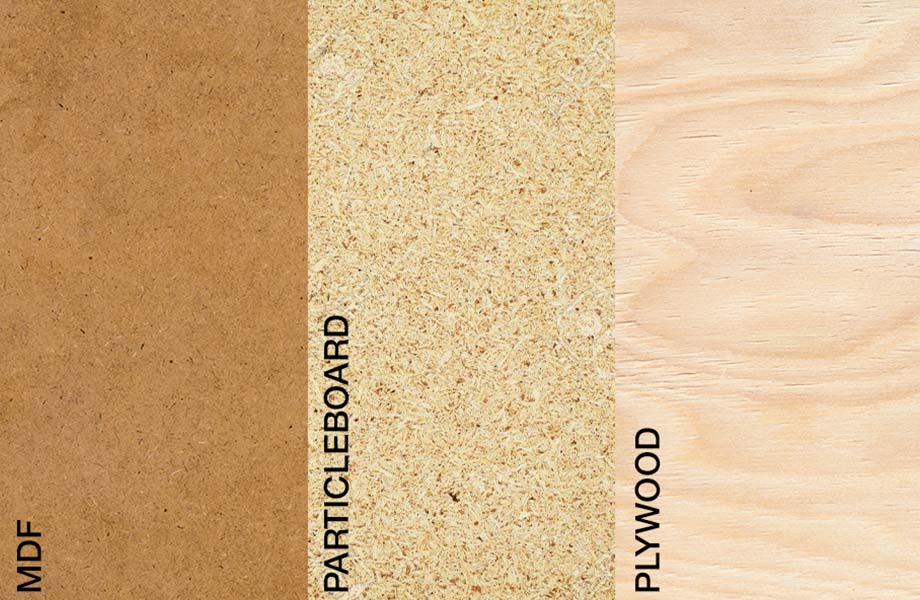
Substrates at a Glance
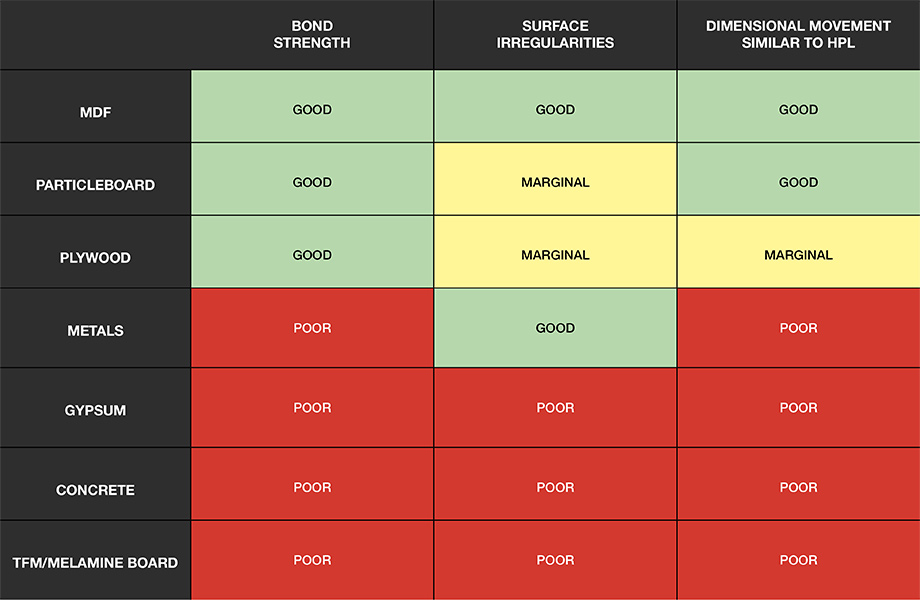
- MDF (GOOD) – MDF or Medium Density Fiberboard is also an engineered wood product made by breaking down hardwood and softwood into its fibers and combined with a wax and resin binder by applying high temperature and pressures. The surface is flat, smooth, and free of knots and is a good choice for decorative surfaces. It is stronger and much more dense than particleboard.
- PARTICLEBOARD (GOOD) – Particleboard is an engineered wood product made from woodchips, shavings and sawdust and bonded together with a synthetic resin binder which is pressed and extruded. A density of 45lb/ft3 is recommended. It is economical, lightweight with good screw holding strength. Additives for various performance characteristics can be added such as fire and water resistance.
- PLYWOOD (MARGINAL) – Plywood is an engineered wood made from thin sheets of wood or piles. Layers are glued together with each layer at right angles for better strength. The alteration of the grain reduces expansion and contraction and makes for consistent strength in all directions. If you choose to use plywood, Formica Corporation recommends “A” faced, hardwood, veneer or multiply core plywood.
- STEEL/ALUMINUM (POOR) – Bonding HPL and other decorative surfaces to metal substrate which offers a structural strength has its challenges (see Metal Substrates Technical Brief). Since metals move with temperature but HPL and other surfaces may move with humidity these two conditions can counteract each other causing bond failure.
- SUBSTRATES NOT RECOMMENDED – Gypsum, Concrete Surfaces, Plaster or TFM. These surfaces have inadequate bond strength due to irregular surface and moisture transfer issues
Ultimately, the right balance comes down to understanding the environment, usage and budget. By aligning substrate selection with performance needs, fabricators and designers can optimize both cost and longevity while maintaining the design intent of the finished surface.
Always consult the technical documents related to decorative surfacing substrates on Formica.com when making your decision.


